The best new garage door installation is not determined on installation day. It is determined in the three or four decisions that come before the door ever arrives: which door was chosen and why, whether the opening was assessed before ordering, whether the spring specification was matched to the door’s actual weight, and whether the installer who showed up had the parts, knowledge, and time to finish the job completely in a single visit. After 22 years of installations across Eatonton and central Georgia, we know which decisions separate a door that runs quietly for 20 years from one that causes problems within the first season.
Start With the Door Selection, Not the Price
Door selection and installation are not two separate decisions. They are one integrated decision, but most homeowners begin the conversation with price rather than the door itself.
The door’s weight determines the spring specification. Its height determines the track configuration. Its style affects the header bracket placement. Its weight and size determine opener compatibility. An installer who had no input on the door selection is solving problems at installation that a ten-minute conversation before ordering would have prevented.
We have completed installations where the homeowner chose a door before calling us, and it was a perfectly good product that was wrong for the opening. The weight exceeded the existing opener’s rating and the height required a track configuration that would have been caught in a pre-order conversation. Finding those things before ordering costs nothing. Finding them when the door is sitting on the driveway costs time neither party budgeted for.
Assess the Opening Before You Order Anything
Before a new garage door is ordered, the opening needs to be assessed. Measuring gives you dimensions. Assessing tells you what condition the opening is in and whether it will affect the installation.
We have replaced doors where the opening was never assessed and discovered on installation day that the framing on one side was rotted at the base of the jamb. The bracket mounting was compromised, which changed how the track needed to be anchored and added time the homeowner had not budgeted for. Finding that before ordering gives the homeowner time to address it on their own terms rather than scrambling while the installer is waiting.
Before calling for a quote, look for visible wood rot, paint peeling from moisture, or a door that never sat evenly in the opening. None of those require expertise. They require five minutes.
Choose Insulation Level Based on How Your Garage Actually Functions
Most homeowners choose insulation level based on price or catalog appearance. The decision should be driven by the garage’s physical relationship to the living spaces around it.
A fully insulated door on a detached garage delivers minimal measurable return. The same door on an attached garage sharing a wall with a bedroom in central Georgia, where summer temperatures can push the garage interior well above 100 degrees, pays for itself in energy cost and comfort. We consistently recommend insulated doors for attached garages in this region because the thermal load on adjacent living spaces is measurable and year-round.
If the garage shares walls or a ceiling with any living space, insulation is a functional investment. If not, the return is primarily comfort during time spent in the garage.
Know What Panel Style Means for Maintenance in This Climate
Panel style is treated as purely aesthetic by most homeowners. In central Georgia’s climate it carries maintenance implications worth knowing before ordering.
Raised-panel steel doors collect debris in the panel channels. During central Georgia’s pollen-heavy spring season, those channels fill with organic material that traps moisture against the panel seams and accelerates rust at the interior face. We have seen raised-panel doors less than five years old with significant interior seam rust because the channels had been collecting moisture since installation. The exterior of those same doors looked fine.
Flush or short-raised panels have fewer debris traps, clean more easily, and dry faster after rain.
Spring Sizing Is the Most Consequential Technical Decision in the Installation
The spring that goes on a new door should be sized for that door’s actual weight, not defaulted to whatever was on the old door.
DASMA, the Door and Access Systems Manufacturers Association, establishes spring cycle ratings as part of its standards for residential garage door components. Standard springs are rated at 10,000 cycles and high-cycle options at 25,000 or more. The cycle rating matters less than the tension specification, because a spring wound to the wrong tension fails prematurely regardless of its cycle rating.
We have replaced springs on new installations done by other companies within six months because the spring was sized for a lighter door than the one installed. The door was new. The opener was new. The spring was wrong from the first cycle and the opener compensated for that imbalance on every use until the spring failed.
The Balance Test Is the Quality Check That Matters Most
A new door that passes a balance test after installation was correctly sprung. One that fails it was not, and the opener is already compensating on every cycle.
With the opener disconnected using the manual release cord, lift the door to mid-height and release it. A correctly installed door holds its position. A door that drops or floats has a spring tension problem that should have been corrected before the opener was connected.
Before the technician leaves, ask to see this test performed. In 22 years of installation work, we have never been unable to perform it when asked. A technician who will not perform it is telling you something about the spring sizing that preceded it.
What a Complete Opener Integration Actually Includes
The steps most commonly skipped in opener integration are the ones that affect safety long after installation day.
A complete opener integration covers ceiling bracket and rail mounting, force and limit calibration, safety sensor alignment at six inches from the floor on each side, remote and keypad programming, app connectivity setup, and a safety reverse test. Under UL 325, the safety standard governing residential garage door openers, a functioning auto-reverse is required. An installation that has not verified this is not finished.
We have completed installations covering a new motor, belt drive rail, exterior keypad, and full app setup in a single visit when every step is followed and the installer arrives with the right parts.
Weather Seal Fit Is the Detail Most Commonly Rushed
The bottom weather seal is one of the last steps in a new installation and one of the most frequently done incorrectly.
A sweep set too low drags against every surface irregularity on every cycle and wears through within months. A sweep set too high leaves a gap for water, pests, and outside air. We have been called back to other companies’ installations specifically because the bottom seal was wrong. It is a five-minute adjustment that gets skipped when an installer is moving toward the next job.
After installation, look at the seal from inside the garage. It should be in full contact with the floor across the full width of the opening. A visible gap is a five-minute conversation with the installer while they are still on-site.
What Installation Day Should Look Like From Start to Finish
We have completed full two-door installations where both doors were measured, assembled, hung, balanced, and tested in a single visit with the garage left completely clean. That is what a finished installation looks like.
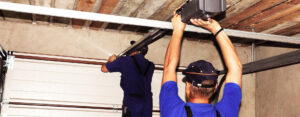
The sequence begins with confirming measurements before unloading, then removing the old door and hardware, assessing the opening for framing issues, mounting new tracks checked for plumb and level, installing and sizing the springs, assembling and hanging the panels, performing the balance test before connecting the opener, integrating the opener, testing sensor function and remote range, adjusting the weather seal, and cleaning the work area before leaving.
If any of those steps are skipped, the installation is not finished.
How to Evaluate Your Installer Before the Job and After It
Before the job, ask how the spring will be sized and whether the opening is assessed before confirming the order. Those two questions reveal whether the installer treats the job as a system or a product delivery.
After the job, ask to see the balance test and the sensor reverse test, look at the weather seal against the floor, and confirm the work area is clean. A technician who works through all four without hesitation completed the installation.
What 22 Years of Installations Comes Down to This
The best new garage door installation is the one where every decision made before the door arrived was the right one and every step on installation day was followed through rather than rushed.
The doors that still run correctly after 15 or 20 years share one characteristic. Every detail was done correctly the first time. The opening was assessed. The spring was sized right. The balance was tested before the first button press. The weather seal was adjusted before the truck left the driveway.
Garage Door Doctor has been delivering new garage door installations across Eatonton, Milledgeville, Madison, Greensboro, and central Georgia for over 22 years. Schedule your assessment with Garage Door Doctor today and find out what a properly done installation actually looks like.